
One of the important decisions at the beginning of your IoT project development will be to choose the right wireless protocol. Today, there are two dominant wireless protocols available on the market for IoT projects - Bluetooth and WiFi. Each of them has its own features and drawbacks, which is why the selection process may be more complicated than you thought.
In this article, we will compare IoT Bluetooth vs WiFi. Let's look at the main characteristics of Bluetooth and WiFi wireless networks according to their operating range, as well as their speed characteristics, power consumption, security features and proposed implementation scenarios. Let's get started!
🤓 Understanding Bluetooth for IoT
Your wearable devices, auto-ID locks, headphones, electric blinds or smart home outlets can be powered by BLE technology all day long. The magic power of Bluetooth Low Energy (BLE) works as a low-power structure in IoT networks.
The principle of Bluetooth operation in IoT technology remains unclear to the general public. Let's figure this out before comparing Bluetooth vs WiFi IoT.
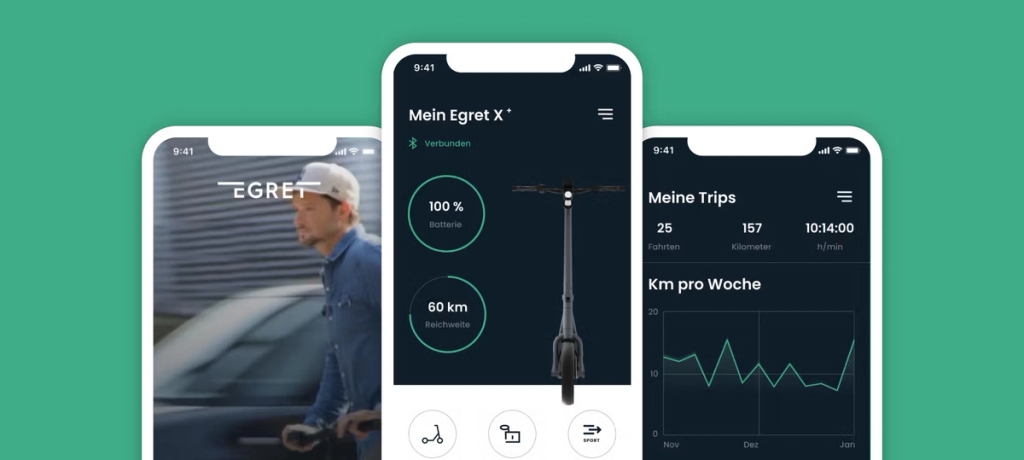
Case Study from Stormotion with Bluetooth technology implementation - Egrett app
(image by Stormotion)
How Bluetooth Works
Bluetooth is a wireless technology protocol that relies on physical proximity to establish a connection between devices without requiring a password. The short-range radio waves used by Bluetooth operate in the 2.4 GHz band. Low-power local connections are best suited for Bluetooth because they function without the need for constant internet access.
In the IoT realm, there are two main versions of Bluetooth technology:
- Bluetooth Classic is great for long-lasting digital data transmission in situations such as wireless speakers, etc.
- Bluetooth Low Energy (BLE) is the preferred choice for IoT sensors and wearable devices as it is best suited for smart devices due to its energy efficiency.
Bluetooth Low Energy is the primary choice for use in the Internet of Things. The technology provides efficient data transfer with minimal power consumption, which is very important for devices that will operate autonomously for months to years.
Key Features of Bluetooth for IoT
Have questions about integrating Bluetooth into your system? We're here to help!
Contact Our Team!
❓Why Choose Bluetooth for IoT?
Bluetooth is not a one-size-fits-all solution, but it's a great fit for specific IoT applications that prioritize:
- Energy efficiency - ideal for sensors and battery-powered wearable devices.
- Short-range connectivity - great for proximity-based interactions.
- Easy to set up - simple pairing without setting up a network.
If your IoT device requires constant high-speed data transfer or long-range communication, Bluetooth alone won't do the trick. However, for applications such as smart home automation, health tracking and asset monitoring, BLE is a no-brainer.
🌐 Real-World Applications of Bluetooth in IoT
Bluetooth technology can be used in various areas, for example:
- Wearable devices – smart watches, fitness bracelets, devices for diabetics, etc.
- Smart homes – smart locks, temperature sensors, and wireless light bulbs.
- Industrial Internet of Things – machine tracking, factory automation, and remote sensors.
- Retail and marketing – Bluetooth beacons for in-store promotion and navigation.
Still unsure whether Bluetooth is right for your IoT product? Let's clarify together.
Get in Touch!
📡 Understanding Wi-Fi for IoT
Your smart thermostat is able to automatically adjust the room temperature after you arrive thanks to Wi-Fi and internet connectivity, and your security cameras transmit real-time video to your cell phone. The power of Wi-Fi in the IoT functions as a technology that allows devices to stay connected to transfer significant amounts of data in real time.
How exactly does Wi-Fi function in IoT networks? Let's break it down.
How Wi-Fi Works
Wireless Fidelity or Wi-Fi is a technological system that provides internet access between devices without the use of physical wires. With its high-speed capabilities over long distances, Wi-Fi is different from Bluetooth because its main goal is to connect low-power devices while maintaining a short wireless range.
Here's how it works:
- A Wi-Fi router acts as a network center that transmits wireless signals throughout the coverage area.
- Smart home devices, security cameras, and industrial sensors connect to this router.
- 2, 4, and 6 GHz frequency bands, as well as 2.4 GHz, provide fast data transfer and reliable communication.
IoT devices connected via Wi-Fi can continuously transmit large data streams, which is the optimal solution for rooms equipped with smart functionality, automated industrial facilities and cloud devices.
Key Features of Wi-Fi for IoT
❔ Why Choose Wi-Fi for IoT?
When you need to connect IoT devices, Wi-Fi is also a good option. The advantages of a Wi-Fi connection include:
- Constant Internet connection - useful in the case of cloud storage.
- Fast data transfer - you can watch videos in real-time (cases with video surveillance in a house or large warehouses) or download large files.
- Long range - suitable for both smart homes and industrial networks.
📱 Real-World Applications of Wi-Fi in IoT
As you can already see, Wi-Fi connectivity is suitable for larger-scale solutions. Among the real-world cases of using Wi-Fi for IoT are the following:
- Smart homes - various thermostats, video surveillance cameras, smart interior elements, and voice assistants.
- Smart cities - video surveillance on the streets, traffic management, and cameras on the roads.
- Healthcare - telemedicine and tracking of patient indicators from medical equipment
Need help integrating Wi-Fi into your product? Our experts are ready to assist.
Talk to Us!
🔑 Key Differences Between Bluetooth and Wi-Fi for IoT
The main difference between Bluetooth and Wi-Fi lies in their capabilities: Bluetooth provides efficient data transfer over short distances while consuming little energy, while Wi-Fi is the primary protocol for high-speed Internet applications.
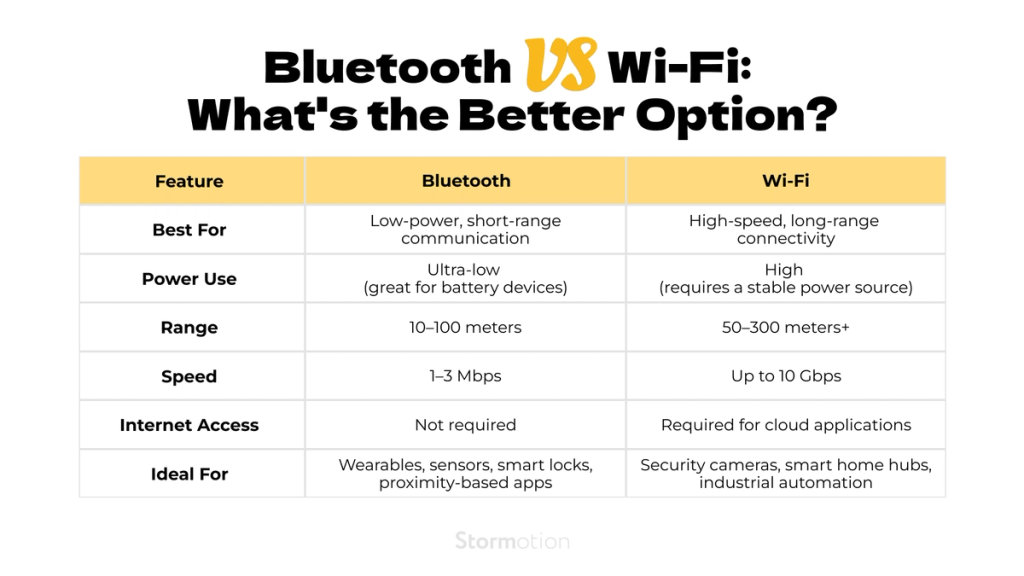
But let's take a closer look at the differences between these two technologies in terms of various parameters. Below, we have prepared a comprehensive table to compare Wi-Fi vs. Bluetooth IoT, helping you decide which technology is best for you.
Bluetooth vs Wi-Fi for IoT
💡 If your IoT device needs mobility within a confined space (e.g., a smartwatch or fitness tracker), Bluetooth is the better choice. If it needs to communicate across rooms or buildings, Wi-Fi is the way to go.
💡 If your IoT device just needs to send small bits of data occasionally, Bluetooth is enough. If it requires continuous data transfer (e.g., a smart security camera), Wi-Fi is the better choice.
💡 If your device runs on batteries and needs to last a long time, Bluetooth is the better choice. If it’s plugged in and requires a continuous internet connection, Wi-Fi works best.
💡 Wi-Fi is generally more secure due to stronger encryption standards, but Bluetooth is less likely to be exploited remotely.
💡 If your IoT device needs a simple plug-and-play experience, Bluetooth is better. If it requires high-speed internet and can handle more setup complexity, Wi-Fi is the choice.
Choosing between Bluetooth and Wi-Fi IoT doesn’t have to be hard — we can help you decide.
Let’s Discuss!
👂 Takeaways
The decision to use Bluetooth or Wi-Fi in an IoT project does not depend solely on which technology is faster or has a longer range. Instead, you should base your decision on the characteristics of your project and choose the most energy-efficient technology. When considering IoT devices using Bluetooth or Wi-Fi, it's essential to use the right technology in the right device.
So, when should you use Bluetooth, and when should you use Wi-Fi? Let's summarize:
We hope this article has been helpful and that you now feel confident in choosing the right technology for your needs. If you still have questions or are considering a project that requires assistance with Wi-Fi or Bluetooth connectivity, please contact us and we will help you get everything done quickly and efficiently!