Modern technology is far beyond simple chatbots that provide automatic responses to different inquiries. Two of the biggest fields where technology is already disruptive but still has a lot of potential to release are Machine Learning (ML) and Artificial Intelligence (AI).
In this article, we’re going to talk about them in the context of meditation, mindfulness, and personal growth — industries where the efficiency of digital products highly depends on one’s always shifty mood and mental state — and where a health and fitness app development company can bring specialized design expertise. For that matter, those also require high-level personalization and an easy-to-train engine.
Plus, it’s essential to track one’s progress and spot any changes in indicators like heart rate while doing yoga, listening to a motivational speech, or processing an inner trauma within a certain course - all that to track a body’s reaction to internal/external irritants and make relevant recommendations.
Let’s take a look at how Machine Learning and Artificial Intelligence can contribute to handling these challenges and talk about a couple of real-life examples of applying such tech solutions.
📲 How Machine Learning Helps with Meditations Products’ Personalization
Apart from the fact that such products need to adjust their content to one’s interests, it’s also necessary to make real-time activity measurements to be able to instantly spot changes in user preferences. Machine Learning can easily help companies with these tasks. Let’s take a closer look at what capabilities Machine Learning has to offer to the meditation and mindfulness industry.
You can also read about how to create your own LLM model to enhance these capabilities.
Meditation Machine Learning Use Cases 📝
First of all, it allows you to enable a smart search function for your app or website. Let’s say a user types in “relaxation after a long day” — what your digital product should offer them? That’s where machine learning tools step in. It allows you to train the engine to give all results under the category “Stress-relief meditations” for inquiries that contain certain keywords — in our case, it could be “relaxation” and “long day”.
Another use case could be making various measurements in real-time. It could be a course bounce rate, for example. Knowing such metrics, you can easily improve your marketing strategies (retargeting, for example) and make it generally more efficient.
Additionally, Machine Learning can process in-app user behavior and biometric indicators (heart rate, strains, etc.) to make personalized course/class recommendations. Recommendations don’t have to be regarding your products only. You can increase your personalization level and report users in case your tools spot any abnormal body activities.
If you’d like to learn about the importance of personalization in meditations apps and how it influences the whole app’s functionality more, feel free to follow the link to our meditation app development article:
To show you how the use of such tools can (positively) influence your business metrics and get into more details in terms of implementing them, we’re going to review how Calm, one of the most popular meditation and mindfulness companies, uses machine learning.
Calm Case Study: Machine Learning 🧘
Calm is one of the world’s most widespread meditation & mindfulness apps. It contains hundreds of meditations targeted at different needs from fighting anxiety to increasing the sense of your own value. Users can choose out of unguided and voice-guided sessions that last 3-30 minutes.
Without further ado, let’s dive into how Calm uses machine learning. In general, most of the user data that Calm gathers then gets transferred to a third-party machine learning system. The results of machine learning processing are then used by multiple departments in the company — Marketing, Customer Experience, Engineering.
The marketing department, for example, found out that what brings Calm most users was actually their sleep stories (bed stories for adults, as they call it) — they got this information via the machine learning tools. Also, the tools showed them that it’s Calm’s daily meditation content that makes users stay. Surely, such information is essential for most of any company’s marketing activities as it can be used for determining strong and weak sides, developing marketing campaigns, updating already existing content, etc.
Looking at general information is useful so as to get some ideas that you could implement into your own workflow. However, we wouldn’t recommend taking Calm’s case as the gold standard. It’s likely that what worked for them might not work for you the same way. With that in mind, let’s take a closer look at how Calm implemented and is currently using [Amazon Personalize]](https://aws.amazon.com/personalize/?nc1=h_ls){ rel="nofollow" target="_blank" .default-md} — a machine-learning-based tool for personalizing the user experience.
Calm & Amazon Personalize
Calm’s journey to implementing Amazon Personalized started when they partnered up with celebrities to expand the content base. As cool as it may look, soon it turned out that such an unexpectedly rich content diversity can confuse users. Some of them had a hard time finding what they were interested in!
How did the suggestion feature work before the ML implementation?
The app was recommending the most popular sessions while removing the ones a user has already seen. However, the results of metrics analysis showed that while recommended sessions might be the most clicked, they rarely got completed. Meaning that users had low engagement & interest in them. Once Calm found out that there are some issues, they turned to Amazon Personalize.
Two of the main goals that Calm wanted to achieve by using Amazon Personalize were:
- Increase user engagement. It was measured by the average number of days it takes a user to complete a certain piece of content. Such a metric was chosen consciously since Calm’s goal is helping users build healthy relationships with mindfulness, which might mean less time using the app itself. In other words, 5-10 minutes of meditation every day was a better sign for Calm than 1 hour 2 times a week.
- Diversify the content users consume. While the content Calm provides is really diverse, many users tend to choose the same meditation over and over, which isn’t bad, of course. However, they still wanted to draw users’ attention to other content. That’s why the number of repeated plays was limited so that the ML tool doesn’t recommend the same session multiple times, even though a user loves it.
For such goals, Amazon Personalize offered Calm to use a sequence model that is able to learn from the step-by-step process of users choosing and following a piece of content. For example, one of the first things that the ML tools had to learn was that new content is highly popular when first added, but then the interest goes down. That meant that Amazon Personalize needed to be able to catch rapid changes in users’ interests and adjust to them with the help of a real-time tracker.
To better understand how Amazon creates such a learning sequence, let’s take look at its structure:
To measure how the implementation of Amazon Personalize impacted Calm, the company ran some user testings and came to the following results:
- Compared to hand-picked “What’s New” email recommendations, users who received the ones generated via Machine Learning were 1% more likely to finish the suggested content within 24 hours, which might sound like not that different but statistically is a significant increase.
- In another test, Calm tested three groups — with user experience before implementing Machine Learning, “Recommended for You” based on the most popular content, and machine-learning-based recommendations. The last group showed 3,4% higher engagement, which is again a big success.
As you can see, Machine Learning is a great way to optimize personalization processes in your meditation and mindfulness product. However, the challenge in such industries as meditation, personal growth or coaching, lies in the fact that the progress significantly depends on users’ inner state. Luckily, Machine Learning has some tricks to help companies “get into users’ heads.”
Mood Control using Machine Learning 😀
To track users’ inner state, it’s sufficient to monitor their mood regularly — Machine Learning will then adjust the recommendations to the user data and take a bunch of external factors into account. A great example of such an approach is Mindwell, which is also a meditation & mindfulness app that highlights the importance of aiming towards a more stable mood.
The first step is pretty simple — a user needs to choose the desired inner state to reach (“Energized”, for example) and what their mood currently is. Right after the first step is completed, the magic starts to happen.
Mindwell’s system then takes a bunch of outer factors that might impact one’s mood and does it with high-level personalization. It considers a user’s location, time of the day, weather, worldwide political events, significant events in one’s area, etc.
After this behind-the-scenes process is successfully completed, Mindwell offers users meditations that meet their specific goals and background of their inner state the best. Surely, it’s essential to increase the accuracy every single time, which is why Mindwell’s Machine Learning soaks up as much user data as possible. Then it determines the meditation combination that’s most likely to help users stabilize and/or improve their mental well-being based on previous experiences.
❓ Is It Possible to Build your Own Machine Learning Infrastructure for a Meditation App?
Let’s not beat around the bush — the answer is yes, it’s possible to create your own machine learning infrastructure in case you don’t want to use third-party providers. However, it would be more reasonable to ask if it’s worth it.
To answer this question, why don’t we first take a look at what building a machine learning system looks like. Such an infrastructure consists out of:
- Data processing layer that needs to collect and categorize data.
- Configured servers to perform the training on and resources for maintenance.
- Testing frameworks to do version comparisons and testing out algorithms.
- Framework and tools to work with data in real-time & others.
Surely, all that requires deep technical and coding knowledge in the field of machine learning specifically. In case you or your current tech specialists don’t have such, you’ll need to hire a team (freelancers or a software development agency) to build a machine learning infrastructure for you. Plus, you’ll also need to integrate machine learning functionality with the backend of your digital solutions.
Companies with their own infrastructures normally have several teams that are exclusively responsible for certain parts of machine learning. Meaning that you would have to build an additional communication infrastructure and new business processes specifically for the matter of machine learning.
Taking all those factors into account, our verdict would be that it’s not really worth it since there are enough decent third-party providers. This way, you significantly reduce the time and costs needed for machine learning system implementation. Moreover, vendors in this industry normally offer a decent level of customization. However, the final decision is always up to you!
⚙️ Tech Stack, ML & AI Tools for Meditation
In this section, we’ll talk about one of the most useful technologies that a сompany could use to either optimize business processes or create a unique user experience so as to stand out and be ahead of the competition.
Consumer-Grade Electroencephalogram (EEG) Device
This device with an overly complicated name is basically a headband intended to provide real-time metrics to users while they’re meditating. The main idea is to help them understand whether what they’re doing is correct since it’s quite a challenge to get a sense of Zen right at the beginning of any mindfulness journey.
Such devices can be used in multiple industries, however, for meditation and mindfulness, it normally looks the following way:
- They track brain activity and record wave patterns using electrodes.
- The data gets processed.
- Then, the device sends the data to a smartphone and/or app.
This is your place to be creative. For example, Muse transforms this data into sounds of nature. If the device determines that a user’s mind is calm, the app will play something respectively calming like rain or gentle breeze. This way, users get informed that they’re on the right track.
In case a user is anxious, the app will play something rather chaotic so that a user would know that they need to concentrate on positive thoughts more. Even though it’s debatable whether such sounds are suitable for a meditation app, at least a user would know what state they’re actually at.
You could surely think of another implementation way with a completely different approach. But the fact that it’s actually possible for you to show users their progress on a neurobiological level is inspiring.
AI Content Creation
In case you want to create content for your business with lower resource consumption, automate as many business processes as possible, or need help because you simply run out of ideas for the meditation and mindfulness sessions creation, the AI market has quite a lot of solutions to offer.
Artificial Intelligence for creating content normally does it with the help of NLP (Natural Language Processing) and NLG (Natural Language Generation) models. The first one allows machines to understand human language both verbally and in written form. NLG then helps them produce content in human language.
These models are what’s behind the scenes when you type in a request and an AI then gives you a response or any other type of output. In our case, you type in a topic and AI creates a piece of content based on all available data, which might include large numbers of articles on the Internet or some internal resources.
What’s great is that the content would be unique — AI doesn’t simply gather different information from all over the Internet but makes its own piece based on what it has learned. Here are some of the AI providers: Jarvis,
Frase AI Writer, Automated Insights, HypeWrite.
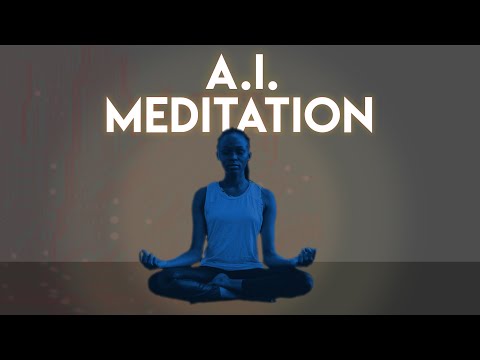
Additionally, there are AIs that can convert the text into natural speech — for example, WaveNet. Here’s a video of a meditation that was created by an AI:
See how you can integrate AI into an app specifically tailored for this industry!
Sound Stimulation for Meditation Practice
Almost every meditation app uses some sort of sound to help users be present, relax, structure their thoughts, separate important from minor — with anything that meditation is intended to do. To make the effectiveness higher, there are a lot of sound stimulative devices.
For example, there’s a device from Welltiss that uses special technology called PEMF (Pulsed Electro-Magnetic Field). It’s used in many industries. For meditation and mindfulness specifically, the device is able to create sounds at a certain frequency so that the brain is practically forced to synchronize with it and fall into much more relaxed but conscious states.
There’s a similar device from BrainTap that’s also able to use lights for additional therapeutic effects. Another more advanced version is provided by OmniPEMF. Practically, most sound stimulative devices use PEMF technology as it’s efficient and harmless to humans. However, there are certain contraindications that you and your users need to be aware of.
Most of the providers listed in this subsection haven’t partnered/integrated with other companies yet. However, there’s a first time for everything and inspiration in everything! 🚀
💡 Takeaways
To sum up, we’d like to say that integrating such technologies into your digital meditation and mindfulness solution should be neither forced nor rashed. As useful as it might be, you should spend some time “observing” your business.
Make a thorough research on what ML & AI might be used for, what it takes to integrate them and what problems they might solve, think about whether you have some of them or not, reach out to ML- or AI-based tools providers or software developers, and then make your decision.
Our team has quite an extensive expertise in this industry and our Meditation App Development company shares this experience with you.
In case you need help with integrating such systems into your app or have any other questions — feel free to contact us. We’d be happy to help you! 🚀